Here is a brief overview of the main research directions in the group.
Programmable self-assembly
Self-assembly is a process where individual components spontaneously organize themselves into structured patterns, from crystalline solids to the very machinery of life. A main goal of our research is to understand the principles behind this spontaneous organization, and learn how to translate these principles into practical design rules. We approach this by trying to connect the attributes of the building blocks to the final structures they form. We are particularly interested in an economical regime of programmable self-assembly where particle species are reused but binding is nondeterministic, meaning that off-target structures are not prevented by the binding rules. While this seriously complicates the design process, we study how high-yield designs can nevertheless be achieved by intelligently choosing the binding rules (the primary design space), and how manipulating binding energies and particle concentrations (the secondary design space) impacts designability and assembly times. Our approach begins by calculating yields using equilibrium statistical mechanics, and ends by working closely with experimental groups to test these theoretical predictions and to help guide the design of novel nanoscale systems.

Select publications:
– MC Hübl and CP Goodrich. Simultaneous optimization of assembly time and yield in programmable self-assembly. [arxiv]
– MC Hübl and CP Goodrich. Stochastic size control of self-assembled filaments. arXiv:2507.04985 (2025). [arxiv]
– MC Hübl, TE Videbæk, D Hayakawa, WB Rogers, and CP Goodrich. The polyhedral structure underlying programmable self-assembly. arXiv:2501.16107 (2025). [arxiv]
– MC Hübl and CP Goodrich. Accessing Semiaddressable Self Assembly with Efficient Structure Enumeration. Phys. Rev. Lett., 134, 058204 (2025). [arxiv]
– AI Curatolo, O Kimchi, CP Goodrich, RK Krueger, and MP Brenner. A computational toolbox for the assembly yield of complex and heterogeneous structures. Nature Communications, 14, Pp. 8328 (2023). [biorxiv]
Mechanisms for smart, programmable nanodevices
How can we program self-assembled nanostructures to not just look a certain way, but behave a certain way or perform a desired task? We seek generalizable, physics-informed design principles in nanostructures with simple physical interactions (e.g., building blocks with patchy binding sites), with the goal of developing de novo nanotechnology with the level of autonomous functionality found, for example, in motor proteins. To achieve this, we adapt a modular approach to systematically learning how to program increasingly complex phenomena into self-assembled nanostructures. For example, we study how rates of structural transitions can be inverse-designed using differentiable programming, and how multiple transitions can be stringed together to achieve emergent functionality. For example, how can an energy-rich structure be stable in solution yet still deliver energy to an energy-poor structure at precisely the right time? We study an ATP-hydrolysis-like energy-delivery mechanism, which demonstrates a pathway for targeted and efficient energy transduction. How can energy delivery be coupled to a three-state structure to drive a non-equilibrium cycle? How can such a cycle perform work that is programmed to a desired task?

Select publications:
– A Ehrmann and CP Goodrich. Controlling energy delivery with bistable nanostructures. arXiv:2506.14266 (2025). [arxiv]
– CP Goodrich,* EM King,* SS Schoenholz, ED Cubuk, and MP Brenner. Designing self-assembling kinetics with differentiable statistical physics models. Proc. Nat. Acad. Sci., 118 (10), e2024083118 (2021). [arxiv]
Mechanical functionality in disordered solids
The mechanical properties of materials are essential to their functionality. Disordered materials, in particular, have significant potential for robust and nontrivial behavior that remains largely untapped. We study emergent behavior in disordered solids as an inverse-design problem. For example, how can the Poission’s ratio, the residual shear stress, or microscopic allosteric responses of a sphere packing be controlled by tuning particle attributes at the species level? Can many such properties be designed simultaneously? We study the extent to which properties are independently tunable both within individual configurations and at the ensemble level, and employ differentiable-programming enabled techniques to perform multi-objective inverse design. We are also interested in how training can lead to emergent memory. Specifically, we study return-point-memory in cyclically trained systems, which we understand through a mechanism called Gradient Discontinuity Learning.

Select publications:
– M Zu and CP Goodrich. Learning by training: emergent return-point memory from cyclically tuning disordered sphere packings. arXiv:2509.01296 (2025). [arxiv]
– M Zu, A Desai, and CP Goodrich. Fully independent response in disordered solids. Phys. Rev. Lett., 134, 238201 (2025). [arxiv]
– M Zu and CP Goodrich. Designing athermal disordered solids with automatic differentiation. Communications Materials, 5, 141 (2024). [arxiv]
– JW Rocks, N Pashine, I Bischofberger, CP Goodrich, AJ Liu, and SR Nagel. “Designing allostery-inspired response in mechanical networks.” Proc. Nat. Acad. Sci., 114, Pp. 2520 (2017). [arxiv]
– CP Goodrich, AJ Liu, and SR Nagel. “The Principle of Independent Bond-Level Response: Tuning by Pruning to Exploit Disorder for Global Behavior.” Phys. Rev. Lett., 114, Pp. 225501 (2015). [arxiv]
Developing differentiable methodologies
To enable our work studying high-dimensional inverse-design problems in programmable matter, we develop and deploy novel computational and theoretical tools. Central to this is differentiable programming, a numerical paradigm that employs methods of automatic differentiation (AD) to propagate derivatives through code. AD powers nearly all modern machine learning methods, yet the direct application of AD to statistical physics models comes with its own challenges, chiefly among them being its high memory consumption for long simulations and numerical stability issues. We combine and develop AD-based techniques, for example using implicit differentiation to efficiently handle multi-level optimization problems. We also study how differentiable path reweighting can enable nontrivial programming of dynamics, and how this can be combined with rare-event-sampling methodologies.

Select publications:
– CP Goodrich,* EM King,* SS Schoenholz, ED Cubuk, and MP Brenner. Designing self-assembling kinetics with differentiable statistical physics models. Proc. Nat. Acad. Sci., 118 (10), e2024083118 (2021). [arxiv]
Disordered Solids and Jamming
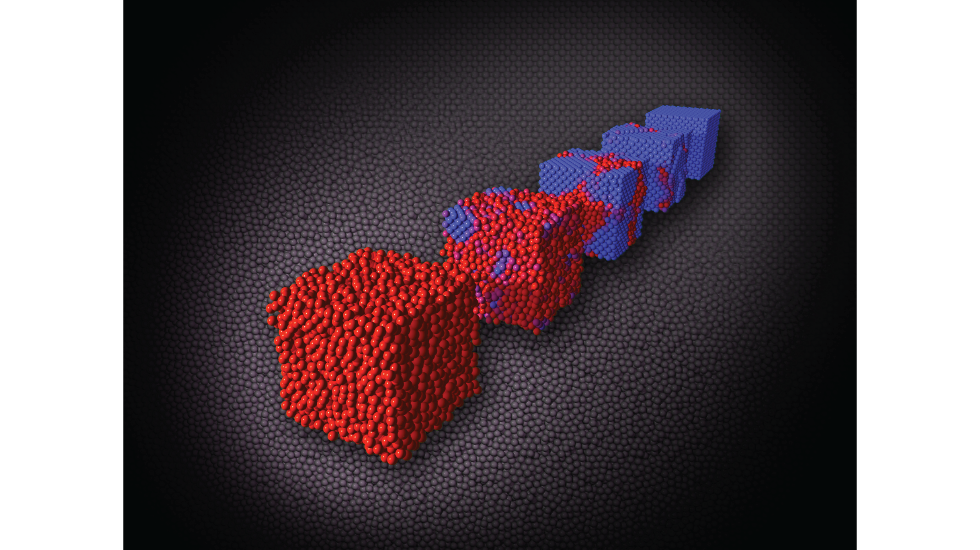
Packings of soft spheres can tell us a lot about disordered solids. At zero temperature and zero applied stress, such systems experience a jamming phase transition as the density of particles is increased. As an out-of-equilibrium critical point, the physics of this transition is highly robust and is believed to be the source of commonality in the behavior of amorphous solids. We are interested in understanding jamming within the context of classical critical phenomena, its connection to real disordered materials, and how our understanding of it can lead to the development of new materials.
Select relevant publications:
– Scaling ansatz for the jamming transition. CP Goodrich, A. J. Liu, and JP Sethna. PNAS, 113, 35, Pp. 9745-9750 (2016).
– Solids between the mechanical extremes of order and disorder. CP Goodrich, A. J. Liu, and SR Nagel. Nature Physics, 10, Pp. 578–581 (2014).
– Finite-Size Scaling at the Jamming Transition. CP Goodrich, AJ Liu, and SR Nagel. Phys. Rev. Lett., 109, pp. 095704 (2012).
Bio-Inspired Material Functionality
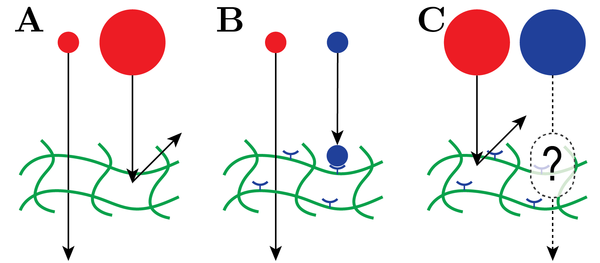
Through billions of years of evolution, biology has discovered rich and complex physical principles that it exploits to create increasingly sophisticated materials. Using such biological systems as motivation, we seek to learn physical mechanisms that generalize beyond the specific biological setting and can be used for develop new materials. For example, the Nuclear Pore Complex contains a hydrogel plug that acts as a very odd selective filter: complexes that bind directly to the gel experience enhanced motion and are allowed through. We study this filtering mechanism in a simplified setting to reveal new and robust physical principles.
Relevant publications:
– Enhanced diffusion by binding to the crosslinks of a polymer gel. CP Goodrich, MP Brenner, and K Ribbeck. Nature Communications, 9, Pp. 4348 (2018).
– Using active colloids as machines to weave and braid on the micrometer scale. CP Goodrich and MP Brenner. PNAS, 114, 2, Pp. 257-262 (2017).